Our political divide often spills into our geographic location. There’s an assumption (wrongly) that only Democrats live in large cities, and only Republicans live in rural areas. Since the U.S. was born as an agrarian society, as citizens, we have a nostalgic feel for rural areas that does not exist when discussing cities.
However, despite the issues created by big-city living, urban areas account for 75% of the nation’s wealth, a sizable share of its economic growth, and a robust job market with a corresponding concentration of skilled people. Yet big cities like New York City face chronic issues due to their size, limited space, human congestion, traffic congestion, and aging infrastructure. In effect, suburbs were born so that people could work in cities without living there. Don’t believe me? Check the traffic cams of any large city and watch the traffic grind to a halt during the morning commute into the city and the evening commute back to suburban conformity.
When a podcast comes along — tethered to a non-profit, do-gooder organization — about abandoned cats that are creating a cat overpopulation problem, there is a collective yawn. The laundry list of urban priorities that supersede cats on the streets is “Empire State Building Tall” in the minds of most residents.
New York City, while vibrant and an economic engine of growth, also faces pressing urban problems, including a housing crisis, the need to bolster its social safety net, and the need to find a more permanent and sustainable solution for street cats.
The organization undergirding the effort is Flatbush Cats, a 501(c)(3) nonprofit working to prevent overcrowded shelters and reduce the outdoor cat population in Brooklyn.
The organization focuses on proven, proactive approaches that keep pets with their families and cats off the street. By increasing access to veterinary care and support services for those who need it most, they reduce shelter surrenders and prevent more cats from ending up on the street.
Flatbush Vet is a high-volume spay/neuter clinic serving both low-income pet owners and rescue/TNR volunteers across Brooklyn. Now performing 7,500+ surgeries each year, the non-profit insists that, “We’re just getting started.”
Will Zweigart is a former advertising executive turned nonprofit leader with a deep passion for solving the overcrowding crisis in New York City's animal shelters and beyond. He founded Flatbush Cats in 2018 as a TNR and rescue volunteer, but soon realized that we cannot rescue or adopt our way out of this crisis. In 2023, Flatbush Cats opened their first nonprofit veterinary clinic, called Flatbush Vet, which provides affordable, high-volume spay-neuter and wellness care to pet owners and rescuers who could not otherwise afford to see a vet.
What’s the connection between chronic problems in the City and abandoned cats? Let’s start with housing. Because of the severe housing crisis in New York City, landlords can impose high rents and strict restrictions on renters. The No Animal Policy is a favorite among landlords. Such a policy forces many families to surrender those dogs and cats, swelling the animal population in the city’s five boroughs.
How does the city or any organization fix the homeless problem if humans and cats share their state of homelessness together?
Urban crime flourishes in neighborhoods with abandoned buildings. The primary residents are homeless people and cats with no home. Clean up that real estate mess, and crime, homelessness, and stray, un-neutered cats become much less common.
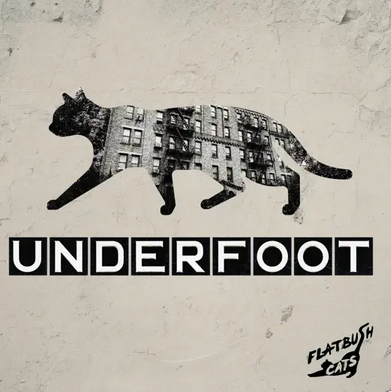
Flatbush Cats also found an effective method of communication via a podcast. Underfoot is a gripping audio documentary about urban crises and their relationship to cats on the street.
Underfoot is a new investigative podcast from the Brooklyn nonprofit Flatbush Cats, uncovering how New York City’s cat overpopulation crisis became a symptom of larger urban failures — in housing, affordability, and access to care.
An estimated half a million cats live outside across New York City, a crisis driven by decades of uneven policy and barriers to affordable veterinary care that leave communities shouldering the response. Through immersive storytelling and interviews with rescuers, policymakers, and neighbors, Underfoot examines what happens when everyday people are left to solve a public problem on their own.
Hosted by Flatbush Cats founder Will Zweigart and producer Virginia Marshall, the six-part series blends field reporting and narrative storytelling — offering an intimate look at how one of the city’s smallest residents reveal so much about its biggest cracks.
This six-part series blends field reporting and narrative storytelling — offering an intimate look at how one of the city’s smallest residents reveals so much about its biggest cracks.
The first episode takes a close look at the cat overpopulation problem, specifically in Flatbush, Brooklyn. We meet Rosario, who heroically tries to care for the street cats in her neighborhood. She links up with an organization that focuses on TNR — trap, neuter, return. The co-hosts then discuss the definition of a colony caretaker, who not only feeds the cats but looks after their overall well-being.
In episode two, we get a higher-level view of the cat problem, but first, they visit with Mike, who went through a period of homelessness and had to give up his beloved dogs. The co-hosts point out that most people give up cats and dogs because of financial problems or because their new landlord does not allow pets.
Mike, who, by now, has found a place in Manhattan, begins a personal vigil to care for cats in Flatbush, an almost two-hour round-trip subway ride. Mike makes the trip every day to take care of cats near the hospital in Flatbush.
Then the episode zooms out, speaking with a NYC Councilman and going through trend reports and data analysis. They find that an estimated half a million cats may live outside across New York City.
In the episode, the co-hosts conclude: “It’s a crisis driven by decades of uneven policy and barriers to affordable veterinary care that leave communities shouldering the response.”
The podcast Underfoot examines what happens when everyday people are left to solve an urban problem on their own. For unheralded heroes like Mike and Rosario and others like them, fixing the cat overpopulation crisis is a positive sign that citizens and government can work together to tackle a host of urban issues.
As English playwright George Bernard Shaw once said, “We are members one of another; so that you cannot injure or help your neighbor without injuring or helping yourself.”
Problems don’t exist in a vacuum. Resolving an urban issue takes a wide field of vision to understand that things that need fixin’ are often interwoven together. Remember that an early sign of psychopathy is cruelty to animals. What does that say about an entire city if they do that?







Comments