The Most Annoying Songs Of 2026 So Far, Ranked By Science
- frakrac6
- 1 day ago
- 4 min read
Earworms serve a dual function. On one hand, they delight our brain and bring joy every time they are replayed in our consciousness. However, their evil twin infects your mind with an earworm that can only be defined as “mangry” (Definition: angry about music we despise). Trying to force the earworm to go away only solidifies its grip on your consciousness.

If you are interested in discovering the most annoying songs of 2026 so far, the experts at SeatPick analyzed the year’s most popular songs according to official top charts, then measured repetition, shrillness, harmonic dullness, and filler lyrics to calculate the percentage chance that listeners would find the song stuck in their head.

SeatPick is a ticket search engine and aggregator for live events, such as concerts, festivals, and sports matches. Similar to Skyscanner or Google Flights, it compiles ticket listings from dozens of secondary resale websites into one place so you can compare prices, seating categories, and availability.
Key findings:
Zara Larsson and PinkPantheress’ Midnight Sun Remix is predicted to be the year’s most irritating song, with an 88% annoyingness score
Sonny Fodera’s recent track ranks as the second most annoying song with an 85.6% probability
Bebe Rexha’s latest single is the third most annoying song of the year
Sabrina Carpenter, Katseye, and Charli XCX also make appearances in the top 15

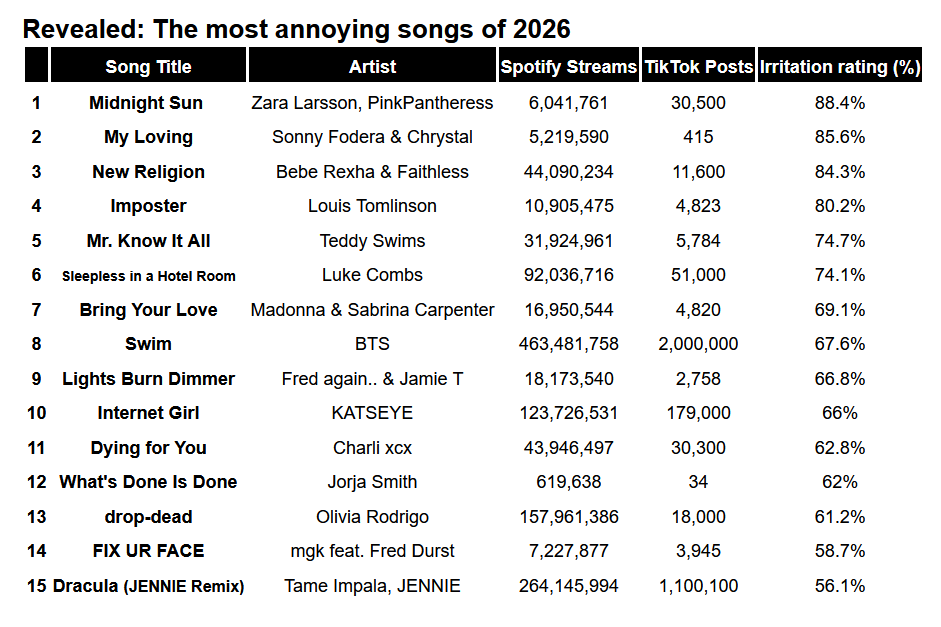
1 . Midnight Sun — Zara Larsson & PinkPantheress (88.4%)
Topping the rankings as 2026’s most annoying song, Midnight Sun earns its place through a combination of relentless repetition and a bright, high-frequency energy that grates on the listener over time. Its repetition score is the highest of any track analyzed, reflecting the song’s hook-driven structure, where melodic phrases cycle back with regularity.
The tempo sits squarely in the sweet spot for catchiness, but what makes a song hard to forget can make it equally hard to bear.
2. My Loving — Sonny Fodera & Chrystal (85.6%)
Sonny Fodera’s production places My Loving firmly in second, driven by a tempo that locks listeners into a repetitive rhythmic loop from the opening line.
The track scores highly on both brightness and harmonic dullness, giving the ear very little variation to latch onto beyond the central hook. Chrystal’s vocal delivery is circular, returning to the same phrase with only minor variation, which pushes the repetition index to the second highest in the dataset and the irritation factor along with it.
3. New Religion — Bebe Rexha & Faithless (84.3%)
Faithless built their reputation on tracks designed to loop endlessly on a dancefloor, and New Religion suggests that instinct remains firmly intact, for better or worse.
The track pairs the highest brightness score among the top 15 with significant harmonic dullness. Bebe Rexha’s vocal power, combined with Faithless’s propulsive production, makes New Religion a song that demands your attention whether you want to give it or not.
4. Imposter — Louis Tomlinson (80.2%)
Imposter marks Louis Tomlinson’s highest entry in the annoyingness rankings, and the acoustic data offers a clear explanation. Its harmonic dullness score is notably high among the top-ranking scores, suggesting a deliberately stripped-back production that places all the weight on the vocal hook, leaving listeners with nowhere else for their attention to go.
5. Mr. Know It All — Teddy Swims (74.7%)
Teddy Swims’s soulful vocal style might seem an unlikely fit for an annoyingness ranking, but the data suggests otherwise. With one of the highest RMS energy readings in the top five, reflecting a consistently loud, full-bodied production, Mr. Know It All commands attention in a way that more restrained tracks do not. It is a reminder that the most grating songs aren’t always the shrillest ones in the room; sometimes they’re simply the most insistent.
Just in case you questioned the science, here is Seatpick's methodology.
Seatpick aimed to determine the most annoying songs of 2026. A list of popular songs released in 2025 was sourced according to official top charts and additional desk research.
Each track was processed through a dedicated ‘earworm index’ pipeline built around four measurable components: Repetition, Brightness (shrillness), Harmonic dullness, and Lyrical filler density.
Tracks were normalized and segmented, then analyzed using high-overlap time windows to detect repeated melodic or lyrical fragments. This step captures looping hooks, motifs, and micro-patterns strongly linked to listener fatigue.
Parallel spectral analysis measured high-frequency dominance and harmonic imbalance, two acoustic traits commonly associated with harsh, piercing, or tiring sound profiles. Where lyrics were available, automated transcription was applied, and a filler-word detector scored the proportion of non-semantic syllables (“yeah”, “uh”, “la”, “ooh”, etc.) relative to total lyrical content.
Each component produced a 0–1 score, which was combined using a weighted formula (Repetition 30%, Brightness 20%, Harmonic Dullness 20%, Filler Density 20%, Baseline 10%).
To calculate the final percentage chance of being an earworm, we applied a logistic (sigmoid) transformation, a standard statistical technique used to map any continuous score onto a 0–100% scale.
All audio analysis was conducted computationally; scores reflect the acoustic properties of the recordings rather than those of subjective listener panels.
The data was collected on 19th May 2026 and is accurate as of then.


Comments